Today we celebrate the 10th Annual Professional Engineers Day—a milestone that honors the dedication, impact, and integrity of PEs. Professional Engineers are the cornerstone of public trust in engineering. As licensed experts, they uphold the highest standards of safety, ethics, and technical excellence—delivering solutions that shape our world and safeguard our future. Every road, bridge, building, system, and innovation that improves lives often has a PE behind it. This is more than a day of recognition—it’s a celebration of leadership, responsibility, and the enduring commitment to making a positive impact in our community.
Becoming a PE is a dedicated process and doesn’t happen overnight. Just a few of the requirements include a bachelor’s degree in engineering or related field, a minimum of four years of post-graduate work experience in your engineering discipline, and passing the initial Fundamentals of Engineering (FE) exam.
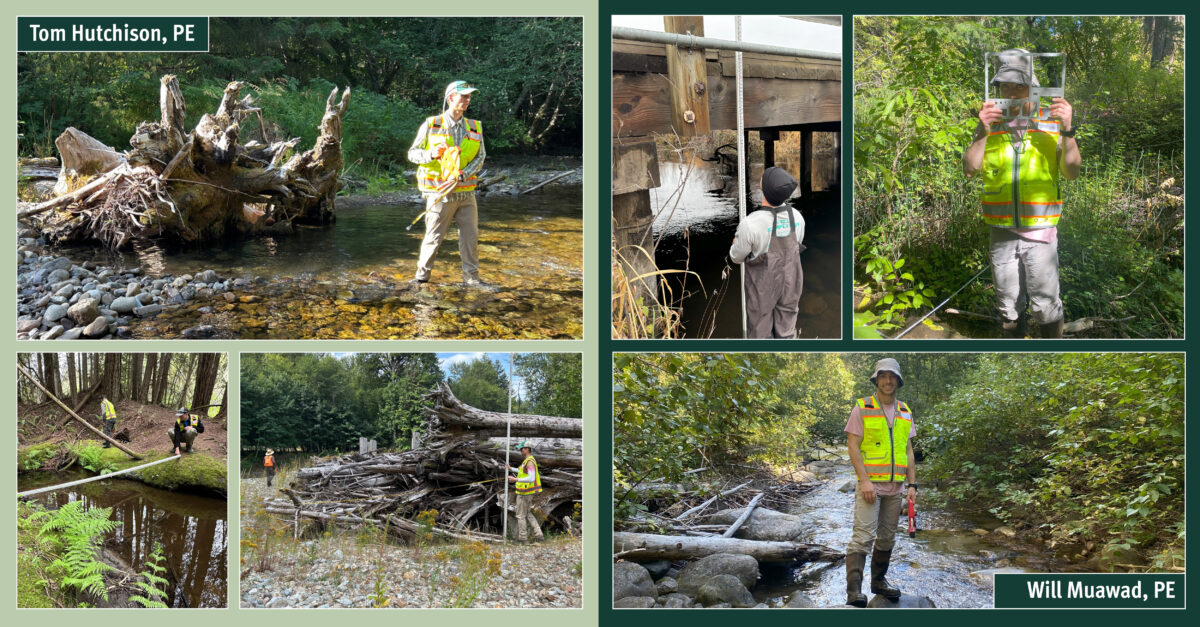
To gain more insight about the process and mindset in preparing to take the PE exam, we spoke to Tom Hutchison, PE and Will Muawad, PE, two of Osborn’s new PEs who recently passed the exam.
Tom Hutchison, PE has been with Osborn for two years. He is an engineer in the Natural Resources group focusing on riverine and estuarine restoration projects and fish passage barrier removal.
Tom emphasizes an interdisciplinary approach to engineering designs that balances ecological, geological, and anthropogenic concerns, among others.
Will Muawad, PE has worked at Osborn for two years. Will is a part of the Eastern Washington practice, with a focus on stormwater engineering, as well as stream restoration and hydraulic engineering. Will uses his breadth of experience to help bring comprehensive solutions to his engineering design work.
What made you decide to go into civil engineering?
Tom: When I was in middle school, I participated in habitat restoration at Lake Sammamish State Park removing invasive species and planting native riparian trees. Through this experience, I became passionate about salmon and restoring their habitat. My academic journey in engineering enabled me to get involved in work that contributes to this cause.
Will: During my freshman year of college, all of the engineering departments came in and gave a presentation about their type of engineering. The discipline that got me most excited was civil and environmental. Environmental engineering gives me the ability to have a hand in design work on different types of outdoor projects.
What motivated you to pursue the PE license and what does achieving it mean to you?
Tom: I know PE licensure is an important step in becoming a certified engineer, it helps Osborn to have more licensed engineers, and it represents a culmination to my studies that began back in undergrad. It means a lot and hopefully I can be a resource to other members of the Osborn team to help navigate this process.
Will: Ever since I finished school and started my professional work journey, I knew that I wanted to pursue and achieve my PE licensure. It is a goal that I set and worked towards, helping me take the next step in my career and Osborn as a company. To me, achieving PE licensure means hard work and dedication. Plus, having the letters “PE” after my name is pretty cool!
What was your study strategy for the PE exam?
Tom: Simply, do as many practice problems and practice exams as possible. With so much material, success is going to be guaranteed by being efficient at solving problems and quickly navigating the reference materials. I took the EET course as well as the full-length practice exam from NCEES to identify strengths and weaknesses.
Will: I first prioritized getting through all of the content, which included watching the study course’s videos, taking notes, and marking down important pieces of content that would appear on the exam. After I finished the content, I focused on specific discipline practice problems and then did multiple practice exams.
What was the most challenging part of preparing for or taking the PE exam and what advice would you give to someone considering the PE journey?
Tom: The most challenging part was self-guided study. I highly recommend signing up for a course as it provides a roadmap for the content you need to cover, as well as checkpoints to help you assess your progress. An additional challenge was gathering the necessary documentation of experience to be able to sit for the exam to verify that you have the necessary number of years of experience.
Will: The most challenging part was setting aside time in my schedule to take the appropriate amount of time to study. I definitely recommend taking some time before jumping into studying to set a to study leading up to the exam date. There is a lot of content to get through and having a week-by-week schedule helped me to stay on track.
Just for fun, what has been your favorite project to work on so far and why?
Tom: I’m currently working on a project on the upper Green River where Osborn is assisting in assessment of previously constructed engineered log jams and restoration projects and helping identify opportunities for future restoration. Anadromous salmonids have been blocked from accessing the upper watershed for more than 100 years and we have the potential to restore and reconnect over 100 miles of habitat all within the protected Tacoma watershed that supplies Tacoma’s drinking water.
Will: I have been working on the City of Wenatchee Confluence Parkway project. It is a large multi-disciplinary progressive design build project, and Osborn is tasked with the stormwater and drainage design for a new section of road and roundabout in Wenatchee. It has been amazing working on a project from the beginning stages through to the 100% design, and now the beginning parts of the project are being constructed!
Congratulations to Tom and Will for your dedication and commitment to pass the exam and earn a PE. We look forward to all the amazing things you’re going to continue to do at Osborn to support our communities!